Fertility Tests
Let’s Understand Your Fertility Health Together
Female Fertility Tests
What Tests you should Look Out For
Female fertility tests, explained clearly—so you know what to do, when to do it, and what your results mean.
Hormones & Ovulation
Understand egg reserve, hormone balance, and whether ovulation is happening as it should. Tests are planned around the right cycle days for accurate results, followed by a clear explanation of what your markers indicate and what steps to take next.
Scan & Uterus Health
Ultrasound-based assessment of the uterus and ovaries to check follicle status, lining health, and common concerns like cysts, PCOS patterns, fibroids, or polyps. You’ll get a simple summary of findings and guidance based on what’s seen.
Tubes & Advanced Screening
For cases that need deeper clarity—checking if the fallopian tubes are open and exploring underlying factors when symptoms or past reports suggest more evaluation. Only relevant tests are advised, with a focused plan to help you move forward confidently.
Male Fertility Tests
What Tests you should Look Out For
From the first consultation onward, we make male fertility testing simple and private—clear test planning, supportive guidance, and results explained without confusion.
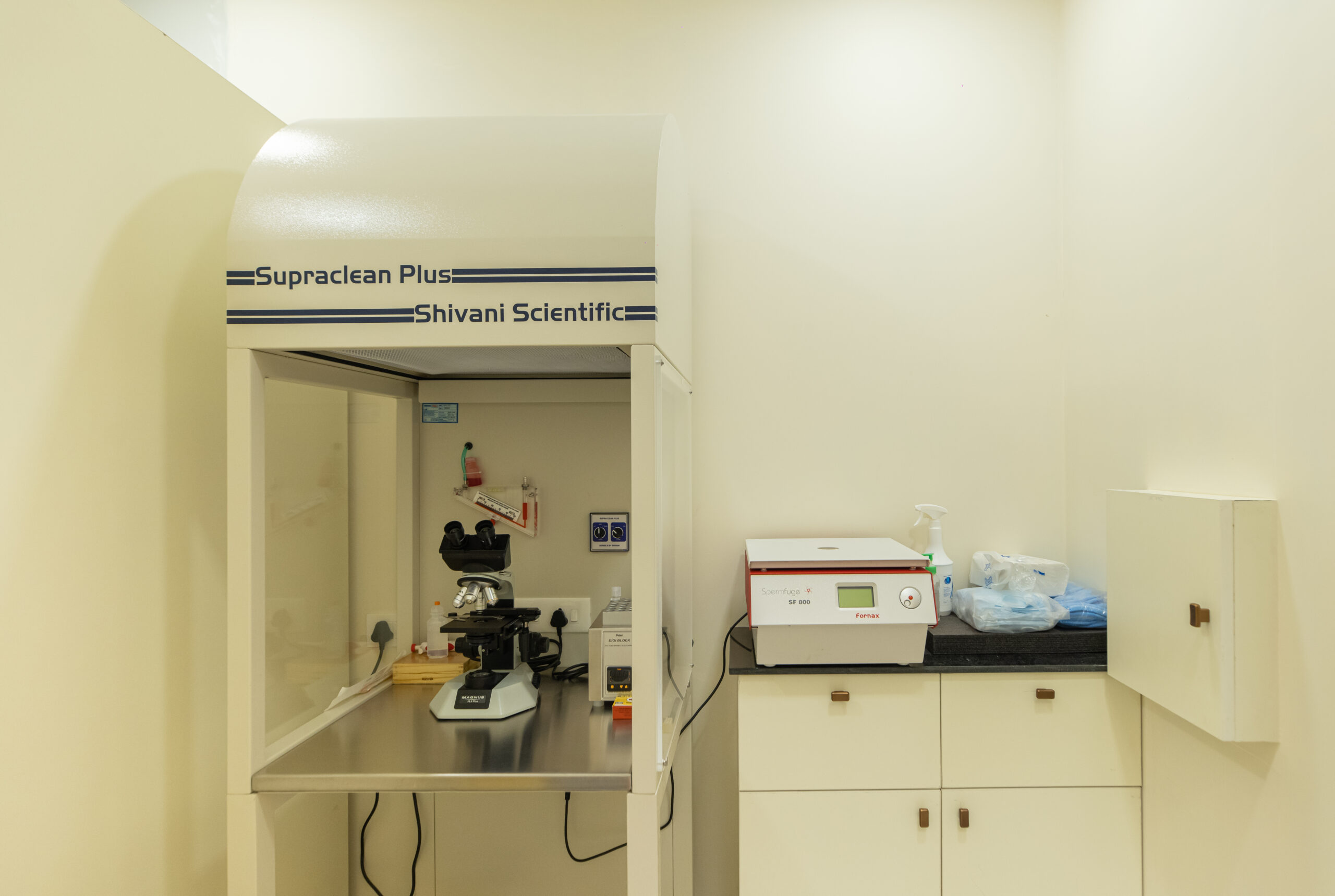
Semen Analysis
A primary test to assess sperm count, motility, and shape. Helps understand male fertility health and guides the right next steps for treatment or lifestyle support.
Infection Sreening
Blood and urine tests to screen for infections that can impact sperm quality and reproductive health. Discreet process with clear guidance on treatment if anything is detected.
Advance Semen Tests
Deeper testing when needed—such as sperm DNA fragmentation or detailed motility/morphology analysis. Useful for repeated IVF failure, recurrent miscarriage, etc.
Trusted Expertise
Led by careful science. Grounded in real empathy.
Mitra Fertility & Beyond is led by, Dr. Vidyalatha, a fertility specialist with deep
experience in both preventive fertility care and advanced reproductive treatments.
- Evidence-based fertility protocols
- Transparent communication and honest counselling
- A calm, private environment that respects how sensitive this journey can be
Our 4-Step Mitra Pathway
Instead of pushing you into the most complex treatment first, we move through a clear, transparent pathway.
Listen & Understand
We begin with a detailed conversation about your health, cycles, lifestyle, and previous reports. No rushed 5-minute consults.
Test & Map
We recommend only the tests that matter for your case—so we can identify the real blockers early (for both partners), without unnecessary panels or confusion.
Decode & Prevent
We walk you through every result in simple language, then build a preventive plan to improve outcomes—cycle support, nutrition, lifestyle, and targeted medical care before stepping into advanced treatment.
Step Up—Only If Needed
If your reports show you need intervention, we move step-by-step—timed cycles, IUI, IVF/ICSI—based on what’s clinically right for you, with clear timelines, transparent options, and ongoing support.
Listen & Understand
We begin with a detailed conversation about your health, cycles, lifestyle, and previous reports. No rushed 5-minute consults.
Test & Map
We recommend only the tests that matter for your case—so we can identify the real blockers early (for both partners), without unnecessary panels or confusion.
Decode & Prevent
We walk you through every result in simple language, then build a preventive plan to improve outcomes—cycle support, nutrition, lifestyle, and targeted medical care before stepping into advanced treatment.
Step Up—Only If Needed
If your reports show you need intervention, we move step-by-step—timed cycles, IUI, IVF/ICSI—based on what’s clinically right for you, with clear timelines, transparent options, and ongoing support.
Questions you might be afraid to ask (but should).
When should we consider fertility testing?
If you’ve been trying for a while without success, have irregular periods, a known medical condition (like PCOS, endometriosis, thyroid issues), past pelvic infections, prior surgeries, or a history that raises questions—fertility testing can bring clarity early and help you plan the right next step.

Do we both need to get tested?
Yes—fertility is shared. Testing both partners early reduces guesswork and avoids unnecessary delays. At Mitra, we keep it simple: identify the real barrier first, then plan from there.
What does a fertility test “package” usually include?
It depends on your cycle and history, but fertility testing typically looks at:
Ovulation and hormones
Ovarian reserve (how the ovaries may respond)
Uterine health (lining and structure)
Tubal status (if needed)
Sperm health (count, motility, morphology)
Mitra tailors testing to your case instead of pushing one fixed package for everyone.
Are fertility tests painful?
Most tests are simple and non-invasive (blood tests, ultrasound, semen analysis). A few tests may cause brief discomfort depending on what’s required. Mitra explains what each test involves beforehand—so there are no surprises.
When is the best time in the cycle to do fertility tests?
Some blood tests and scans are cycle-day specific, while others can be done any time. Mitra maps testing around your cycle so results are accurate and meaningful—not random.
How long does it take to get results?
Many test results come quickly (often within a few days), while some may take longer depending on the lab and test type. Mitra keeps the process structured so you’re not waiting without clarity.
What if all tests are normal but we’re still not conceiving?
That can happen (often called unexplained infertility). In that case, Mitra focuses on timing accuracy, subtle factors, and step-by-step planning—without panic or rushed decisions.
Can lifestyle changes really impact fertility test results?
Yes—sleep, stress, nutrition, weight, smoking/alcohol, vitamin deficiencies, and metabolic health can affect hormones and sperm quality. Mitra helps you focus on practical changes that actually move the needle.
Should I repeat fertility tests?
Sometimes, yes—especially if results are borderline, inconsistent, or influenced by recent illness or timing. Mitra recommends repeats only when it improves clarity and decision-making.
Do abnormal results mean we need IVF immediately?
Not necessarily. Results don’t automatically mean “IVF next.” Mitra’s approach is what’s right for you first—sometimes the next step is lifestyle correction, timed intercourse, ovulation support, or IUI. IVF is considered only when it’s the most logical step.