
IVF Success Rates in 2026: What Really Matters?
Introduction
IVF success rates have significantly improved over the years, and in 2026, advancements in reproductive medicine are giving new hope to couples struggling with infertility. However, one of the biggest misconceptions is that IVF guarantees pregnancy.
The truth is—IVF success depends on multiple factors, not just the procedure itself. Understanding these factors can help you make informed decisions and improve your chances of success.
IVF Success Rates in 2026
In 2026, the average IVF success rate globally ranges between 45% to 65% per cycle.
In India, IVF success rates are comparable, especially in advanced fertility centers, where success rates can go up to 60% depending on patient conditions and treatment protocols.
However, these numbers are not fixed. They vary significantly based on individual health conditions, age, and clinic expertise.
IVF Success Rate by Age
Age remains the most critical factor affecting IVF outcomes.
Under 30 years: 60% – 65% success rate
30–35 years: 50% – 60%
35–40 years: 40% – 50%
Above 40 years: 20% – 35%
As age increases, egg quality and ovarian reserve decline, which directly impacts embryo development and implantation.
Under 30 years: 60% – 65% success rate
30–35 years: 50% – 60%
35–40 years: 40% – 50%
Above 40 years: 20% – 35%
Latest IVF Success Statistics (2026 Trends)
Recent advancements have improved IVF outcomes globally:
AI-based embryo selection improves implantation success
Preimplantation Genetic Testing (PGT) reduces miscarriage risk
Better lab environments and culture techniques enhance embryo quality
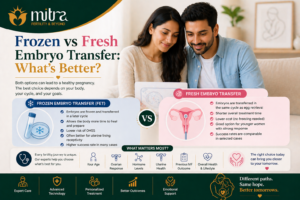
Frozen embryo transfers (FET) now show equal or better success rates than fresh transfers
These innovations are helping clinics achieve more consistent and predictable results.
AI-based embryo selection improves implantation success
Preimplantation Genetic Testing (PGT) reduces miscarriage risk
Better lab environments and culture techniques enhance embryo quality
Frozen embryo transfers (FET) now show equal or better success rates than fresh transfers
Key Factors That Affect IVF Success
Understanding in vitro fertilization success factors is crucial before starting treatment.
1. Egg Quality
Healthy eggs are essential for forming strong embryos. Egg quality naturally declines with age.
2. Sperm Health
Sperm count, motility, and morphology play a major role in fertilization success.
3. Embryo Quality
The better the embryo, the higher the chances of implantation and pregnancy.
4. Uterine Health
A healthy uterus with proper lining thickness supports embryo implantation.
5. Lifestyle Factors
Smoking, alcohol, stress, and poor diet can negatively affect IVF outcomes.
6. Clinic Expertise
The experience of the fertility specialist and lab quality significantly influence results.
IVF Success Rate in India
India has become a leading destination for fertility treatments due to:
Advanced IVF technology
Experienced specialists
Cost-effective treatment options
Top clinics in India report success rates ranging between 50% to 65%, depending on patient profiles.
Advanced IVF technology
Experienced specialists
Cost-effective treatment options
What is the IVF Treatment Success Percentage on First Attempt?
One of the most common questions is: “What are the chances of IVF success on the first try?”
Average success rate for first cycle: 40% to 50%
Higher success for younger patients with good reproductive health
Multiple cycles may increase cumulative success rates to 70% or more
It’s important to understand that IVF often requires patience and multiple attempts.
Average success rate for first cycle: 40% to 50%
Higher success for younger patients with good reproductive health
Multiple cycles may increase cumulative success rates to 70% or more
How to Improve Your Chances of IVF Success
While not all factors are controllable, certain steps can improve outcomes:
Maintain a healthy weight
Follow a fertility-friendly diet
Avoid smoking and alcohol
Manage stress effectively
Choose an experienced fertility clinic
Follow your doctor’s protocol strictly
Maintain a healthy weight
Follow a fertility-friendly diet
Avoid smoking and alcohol
Manage stress effectively
Choose an experienced fertility clinic
Follow your doctor’s protocol strictly
Conclusion
IVF success rates in 2026 are higher than ever—but success is not just about the technology. It’s about timing, health, and the right medical approach.
Every fertility journey is unique. Understanding the factors that influence IVF success can help you set realistic expectations and take the right steps toward parenthood.