

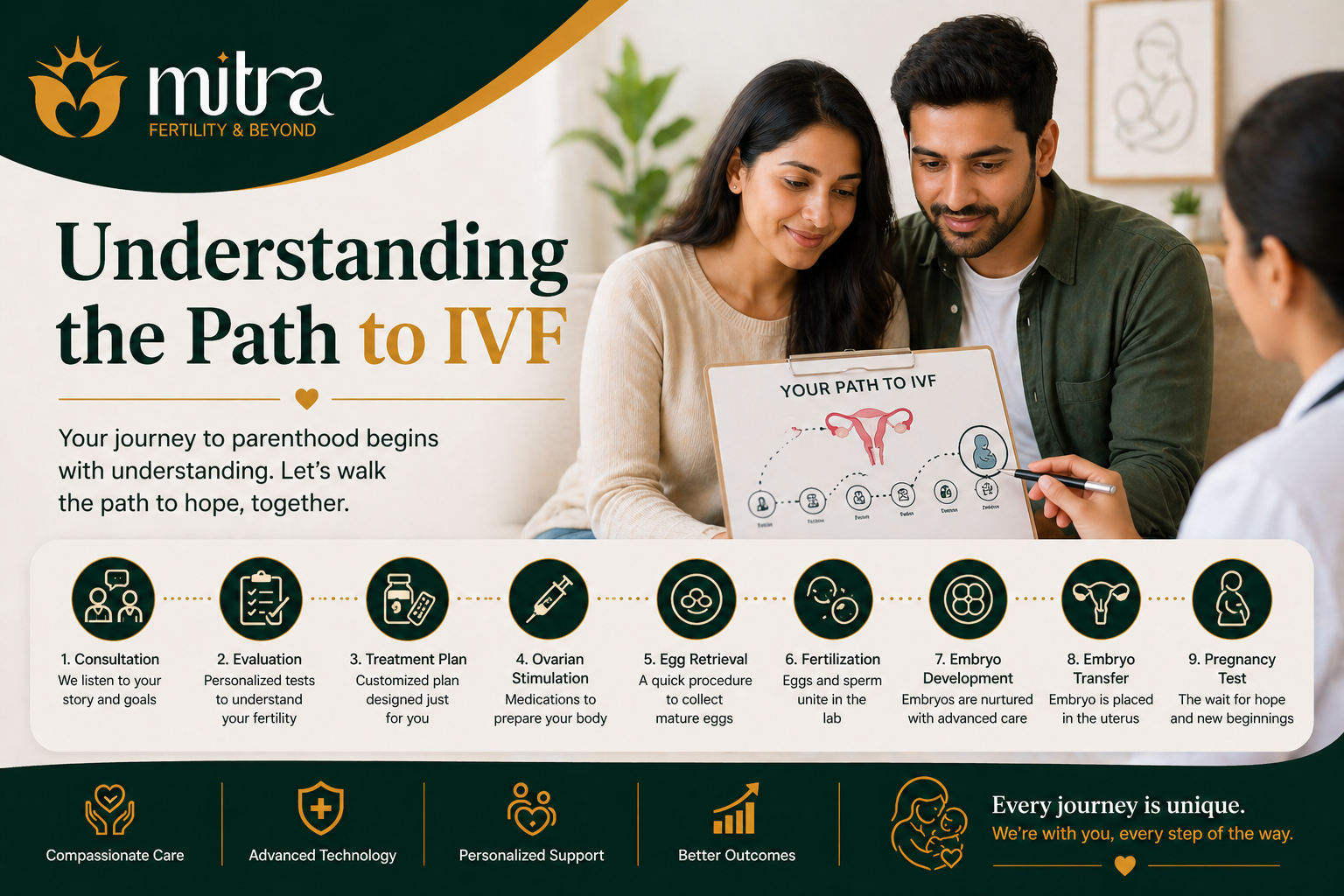
Understanding the Path to IVF
Introduction
For many couples, the journey to parenthood doesn’t always follow a straight path. When natural conception becomes challenging, IVF (In Vitro Fertilization) is often considered as a next step.
But IVF isn’t the first step—it’s part of a larger fertility journey.
Understanding the path to IVF helps you make informed decisions, reduce uncertainty, and approach treatment with clarity and confidence.
What is IVF?
IVF is an advanced fertility treatment where:
Eggs are retrieved from the ovaries
Fertilized with sperm in a laboratory
The resulting embryo is transferred into the uterus
It is designed to overcome various fertility challenges and improve the chances of pregnancy.
Eggs are retrieved from the ovaries
Fertilized with sperm in a laboratory
The resulting embryo is transferred into the uterus
Step 1: Trying to Conceive Naturally
The path to IVF usually begins with natural attempts.
General timeline:
Under 35 years: Try for 12 months
Above 35 years: Try for 6 months
If pregnancy doesn’t occur within this time, further evaluation is recommended.
Under 35 years: Try for 12 months
Above 35 years: Try for 6 months
Step 2: Initial Fertility Evaluation
Before considering IVF, both partners undergo basic fertility testing.
Common tests include:
Hormone tests
Ultrasound scans
Semen analysis
This helps identify the underlying cause of infertility.
Hormone tests
Ultrasound scans
Semen analysis
Step 3: Identifying the Cause
Fertility issues can arise due to:
Female factors:
Irregular ovulation
PCOS
Endometriosis
Blocked fallopian tubes
Irregular ovulation
PCOS
Endometriosis
Blocked fallopian tubes
Male factors:
Low sperm count
Poor sperm motility
Abnormal morphology
Low sperm count
Poor sperm motility
Abnormal morphology
Unexplained infertility:
In some cases, no clear cause is identified.
Step 4: Trying Simpler Treatments First
IVF is not always the first treatment option.
Common initial treatments:
Ovulation induction (medications)
Lifestyle changes
IUI (Intrauterine Insemination)
These are often recommended before moving to IVF.
Ovulation induction (medications)
Lifestyle changes
IUI (Intrauterine Insemination)
Step 5: When is IVF Recommended?
IVF is usually suggested when:
Fallopian tubes are blocked or damaged
Severe male infertility is present
Multiple IUI cycles have failed
Age-related fertility decline
Low ovarian reserve
Unexplained infertility persists
At this stage, IVF offers higher success rates compared to other treatments.
Fallopian tubes are blocked or damaged
Severe male infertility is present
Multiple IUI cycles have failed
Age-related fertility decline
Low ovarian reserve
Unexplained infertility persists
Step 6: Preparing for IVF
Before starting IVF, doctors create a personalized plan.
Preparation includes:
Detailed medical evaluation
Treatment protocol planning
Lifestyle adjustments
Counseling and expectation setting
Preparation plays a key role in improving outcomes.
Detailed medical evaluation
Treatment protocol planning
Lifestyle adjustments
Counseling and expectation setting
Step 7: Emotional Readiness
IVF is not just a medical process—it’s an emotional journey.
It’s normal to feel:
Hopeful
Anxious
Uncertain
Having support from doctors, family, and counselors helps you stay balanced throughout the process.
Hopeful
Anxious
Uncertain
Step 8: Starting the IVF Cycle
Once everything is ready, the IVF process begins, which includes:
Ovarian stimulation
Egg retrieval
Fertilization
Embryo transfer
Each step is carefully monitored to maximize success.
Ovarian stimulation
Egg retrieval
Fertilization
Embryo transfer
Common Misconceptions About IVF
Myth 1: IVF is the First Step
Fact: It is usually considered after simpler treatments.
Myth 2: IVF Guarantees Pregnancy
Fact: It improves chances but does not guarantee success.
Myth 3: IVF is Only for Women
Fact: Male factors play an equal role in fertility.
When Should You Consider Consulting a Specialist?
You should seek guidance if:
You’ve been trying without success
You have irregular cycles
There are known medical conditions
You want to understand your fertility timeline
Early consultation doesn’t mean immediate IVF—it means better planning.
You’ve been trying without success
You have irregular cycles
There are known medical conditions
You want to understand your fertility timeline
Conclusion
The path to IVF is not a single decision—it’s a journey built on understanding, evaluation, and the right timing.
By knowing each step, you can move forward with clarity and make decisions that are best suited to your situation.
IVF is not the beginning—but it can be a powerful step toward achieving your goal of parenthood.

PCOS Has Been Renamed PMOS — Here’s What It Means for Your Fertility
If you have PCOS — or think you might — there is news you need to know about. Yesterday, 12 May 2026, one of the
PGT-A in IVF: Understanding Genetic Embryo Screening
Blogs and Resources PGT-A in IVF: Understanding Genetic Embryo Screening Book Appointment PGT-A in IVF: Understanding Genetic Embryo Screening Introduction IVF treatment has advanced significantly
ICSI vs Conventional IVF: Key Differences Explained
Blogs and Resources ICSI vs Conventional IVF: Key Differences Explained Book Appointment ICSI vs Conventional IVF: Key Differences Explained Introduction When exploring fertility treatments, many
Failed IVF Cycle: Reasons & Next Steps
Blogs and Resources Failed IVF Cycle: Reasons & Next Steps Book Appointment Failed IVF Cycle: Reasons & Next Steps Introduction A failed IVF cycle can

Common IVF Mistakes That Reduce Success Rates
Blogs and Resources Common IVF Mistakes That Reduce Success Rates Book Appointment Common IVF Mistakes That Reduce Success Rates Introduction IVF (In Vitro Fertilization) has

Boost Your Fertility: Lifestyle & Health Tips for Trying to Conceive
Blogs and Resources Boost Your Fertility: Lifestyle & Health Tips for Trying to Conceive Book Appointment Boost Your Fertility: Lifestyle & Health Tips for Trying

Lifestyle Changes That Can Boost Fertility Naturally
Blogs and Resources Lifestyle Changes That Can Boost Fertility Naturally Book Appointment Lifestyle Changes That Can Boost Fertility Naturally Introduction Fertility is not just about

Foods to Eat and Avoid During IVF Treatment
Blogs and Resources Foods to Eat and Avoid During IVF Treatment Book Appointment Foods to Eat and Avoid During IVF Treatment Introduction When undergoing IVF
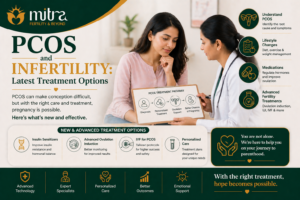
PCOS and Infertility: Latest Treatment Options
Blogs and Resources PCOS and Infertility: Latest Treatment Options Book Appointment PCOS and Infertility: Latest Treatment Options Introduction Polycystic Ovary Syndrome (PCOS) is one of
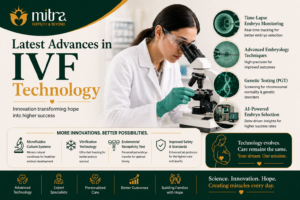
Latest Advances in IVF Technology
Blogs and Resources Latest Advances in IVF Technology Book Appointment Latest Advances in IVF Technology Introduction IVF (In Vitro Fertilization) has come a long way