

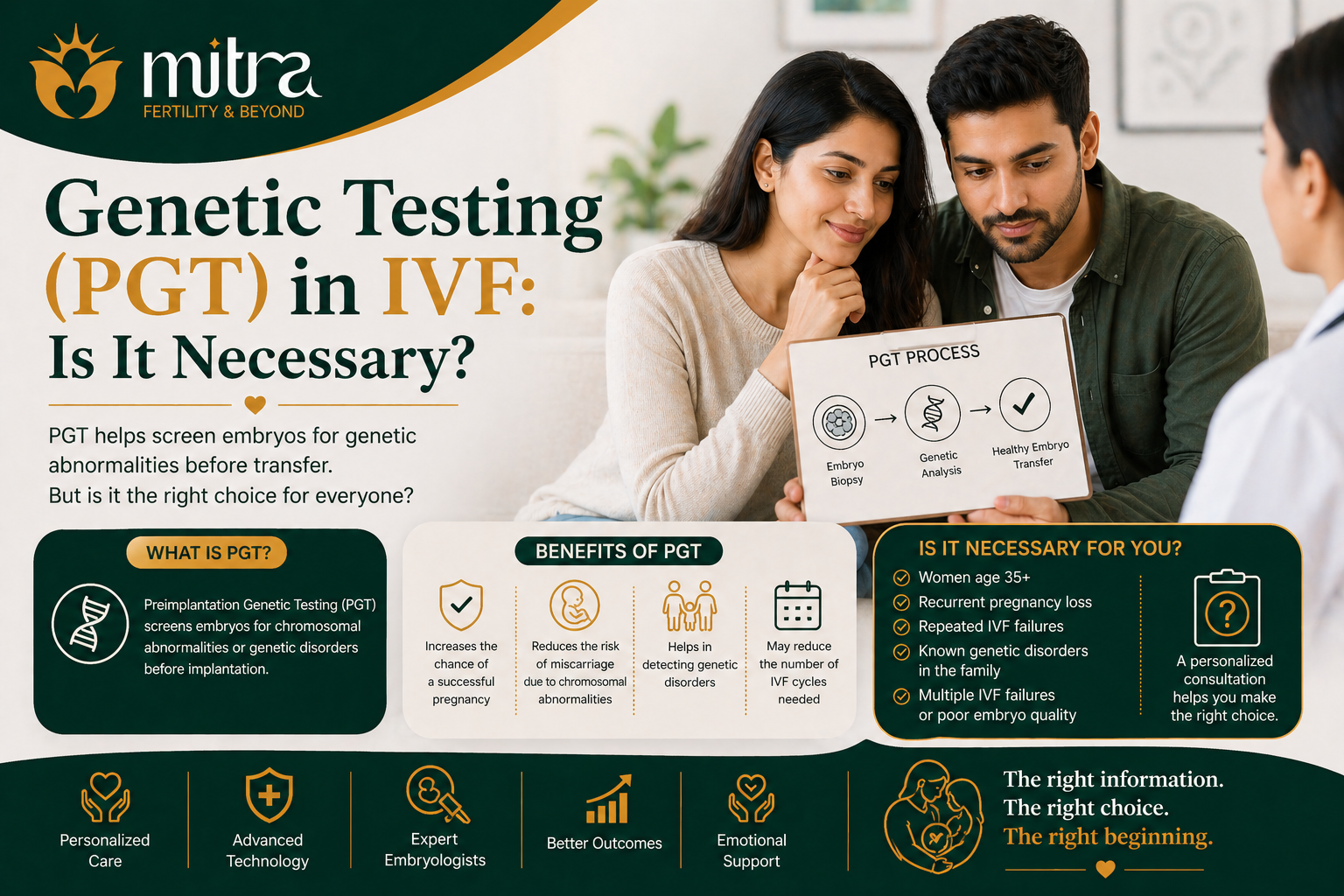
Genetic Testing (PGT) in IVF: Is It Necessary?
Introduction
As IVF technology advances, many couples are introduced to genetic testing of embryos, commonly known as PGT (Preimplantation Genetic Testing).
But a common question arises:
Is PGT necessary for everyone undergoing IVF?
The answer is—not always.
PGT can be a powerful tool in specific situations, but it isn’t required for every IVF case. This guide helps you understand what PGT is, when it’s recommended, and whether it’s right for you.
Is PGT necessary for everyone undergoing IVF?
What is Genetic Testing (PGT) in IVF?
PGT is a laboratory technique used during IVF to test embryos for genetic abnormalities before they are transferred into the uterus.
How it works:
Embryos are created through IVF
A few cells are carefully taken from the embryo
These cells are tested for chromosomal or genetic issues
Only healthy embryos are selected for transfer
Embryos are created through IVF
A few cells are carefully taken from the embryo
These cells are tested for chromosomal or genetic issues
Only healthy embryos are selected for transfer
Types of PGT
1. PGT-A (Aneuploidy Testing)
Checks for the correct number of chromosomes.
Helps identify embryos with missing or extra chromosomes
Reduces risk of implantation failure or miscarriage
Helps identify embryos with missing or extra chromosomes
Reduces risk of implantation failure or miscarriage
2. PGT-M (Monogenic Disorders)
Used when there is a known genetic disorder in the family.
Screens for specific inherited diseases
Helps prevent passing on genetic conditions
Screens for specific inherited diseases
Helps prevent passing on genetic conditions
3. PGT-SR (Structural Rearrangements)
Used when one partner has chromosomal structural abnormalities.
When is PGT Recommended?
PGT is usually advised in specific situations:
1. Advanced Maternal Age (35+)
Higher risk of chromosomal abnormalities in embryos.
2. Repeated IVF Failures
Helps identify genetically normal embryos for transfer.
3. Recurrent Miscarriages
May be caused by chromosomal abnormalities.
4. Known Genetic Disorders
To prevent passing inherited conditions to the baby.
5. Severe Male Infertility
In some cases, may be recommended alongside ICSI.
Is PGT Necessary for Everyone?
No. PGT is not mandatory for all IVF patients.
You may not need PGT if:
You are younger with good egg quality
No history of genetic disorders
First-time IVF with no complications
In such cases, standard IVF may be sufficient.
You are younger with good egg quality
No history of genetic disorders
First-time IVF with no complications
Benefits of PGT
Improves embryo selection
Reduces risk of miscarriage
Increases chances of successful implantation
Helps avoid transferring genetically abnormal embryos
Improves embryo selection
Reduces risk of miscarriage
Increases chances of successful implantation
Helps avoid transferring genetically abnormal embryos
Limitations of PGT
Adds to the overall cost of IVF
Does not guarantee pregnancy
Not all embryos may survive biopsy or testing
Requires advanced lab facilities
PGT improves decision-making—but it’s not a guarantee of success.
Adds to the overall cost of IVF
Does not guarantee pregnancy
Not all embryos may survive biopsy or testing
Requires advanced lab facilities
Does PGT Increase IVF Success Rates?
PGT can improve implantation rates per transfer, especially in certain groups.
However:
It does not increase the total number of embryos
It helps select the best embryo for transfer
Success still depends on:
Age
Egg quality
Uterine health
It does not increase the total number of embryos
It helps select the best embryo for transfer
Age
Egg quality
Uterine health
Cost of PGT in India
PGT testing: ₹1,00,000 – ₹2,50,000 (approx.)
Additional to IVF treatment cost
Costs vary depending on the type of testing and clinic.
PGT testing: ₹1,00,000 – ₹2,50,000 (approx.)
Additional to IVF treatment cost
Common Myths About PGT
Myth 1: PGT Guarantees a Healthy Baby
Fact: It reduces risks but cannot eliminate all possibilities.
Myth 2: Everyone Needs PGT
Fact: It is recommended only in specific cases.
Myth 3: PGT Improves Fertility
Fact: It helps select embryos—it doesn’t improve egg or sperm quality.
How to Decide if PGT is Right for You
The decision depends on:
Your age
Medical history
Previous IVF outcomes
Genetic risk factors
A fertility specialist will guide you based on your specific situation.
Your age
Medical history
Previous IVF outcomes
Genetic risk factors
Conclusion
PGT is a valuable advancement in IVF—but it’s not necessary for everyone.
For some, it can significantly improve outcomes. For others, it may not be required.
The key is personalized treatment—choosing what’s right for your journey, not just what’s available.

PCOS Has Been Renamed PMOS — Here’s What It Means for Your Fertility
If you have PCOS — or think you might — there is news you need to know about. Yesterday, 12 May 2026, one of the
PGT-A in IVF: Understanding Genetic Embryo Screening
Blogs and Resources PGT-A in IVF: Understanding Genetic Embryo Screening Book Appointment PGT-A in IVF: Understanding Genetic Embryo Screening Introduction IVF treatment has advanced significantly
ICSI vs Conventional IVF: Key Differences Explained
Blogs and Resources ICSI vs Conventional IVF: Key Differences Explained Book Appointment ICSI vs Conventional IVF: Key Differences Explained Introduction When exploring fertility treatments, many

Failed IVF Cycle: Reasons & Next Steps
Blogs and Resources Failed IVF Cycle: Reasons & Next Steps Book Appointment Failed IVF Cycle: Reasons & Next Steps Introduction A failed IVF cycle can

Common IVF Mistakes That Reduce Success Rates
Blogs and Resources Common IVF Mistakes That Reduce Success Rates Book Appointment Common IVF Mistakes That Reduce Success Rates Introduction IVF (In Vitro Fertilization) has

Boost Your Fertility: Lifestyle & Health Tips for Trying to Conceive
Blogs and Resources Boost Your Fertility: Lifestyle & Health Tips for Trying to Conceive Book Appointment Boost Your Fertility: Lifestyle & Health Tips for Trying

Lifestyle Changes That Can Boost Fertility Naturally
Blogs and Resources Lifestyle Changes That Can Boost Fertility Naturally Book Appointment Lifestyle Changes That Can Boost Fertility Naturally Introduction Fertility is not just about

Foods to Eat and Avoid During IVF Treatment
Blogs and Resources Foods to Eat and Avoid During IVF Treatment Book Appointment Foods to Eat and Avoid During IVF Treatment Introduction When undergoing IVF
PCOS and Infertility: Latest Treatment Options
Blogs and Resources PCOS and Infertility: Latest Treatment Options Book Appointment PCOS and Infertility: Latest Treatment Options Introduction Polycystic Ovary Syndrome (PCOS) is one of

Latest Advances in IVF Technology
Blogs and Resources Latest Advances in IVF Technology Book Appointment Latest Advances in IVF Technology Introduction IVF (In Vitro Fertilization) has come a long way