

Frozen vs Fresh Embryo Transfer: What’s Better?
Introduction
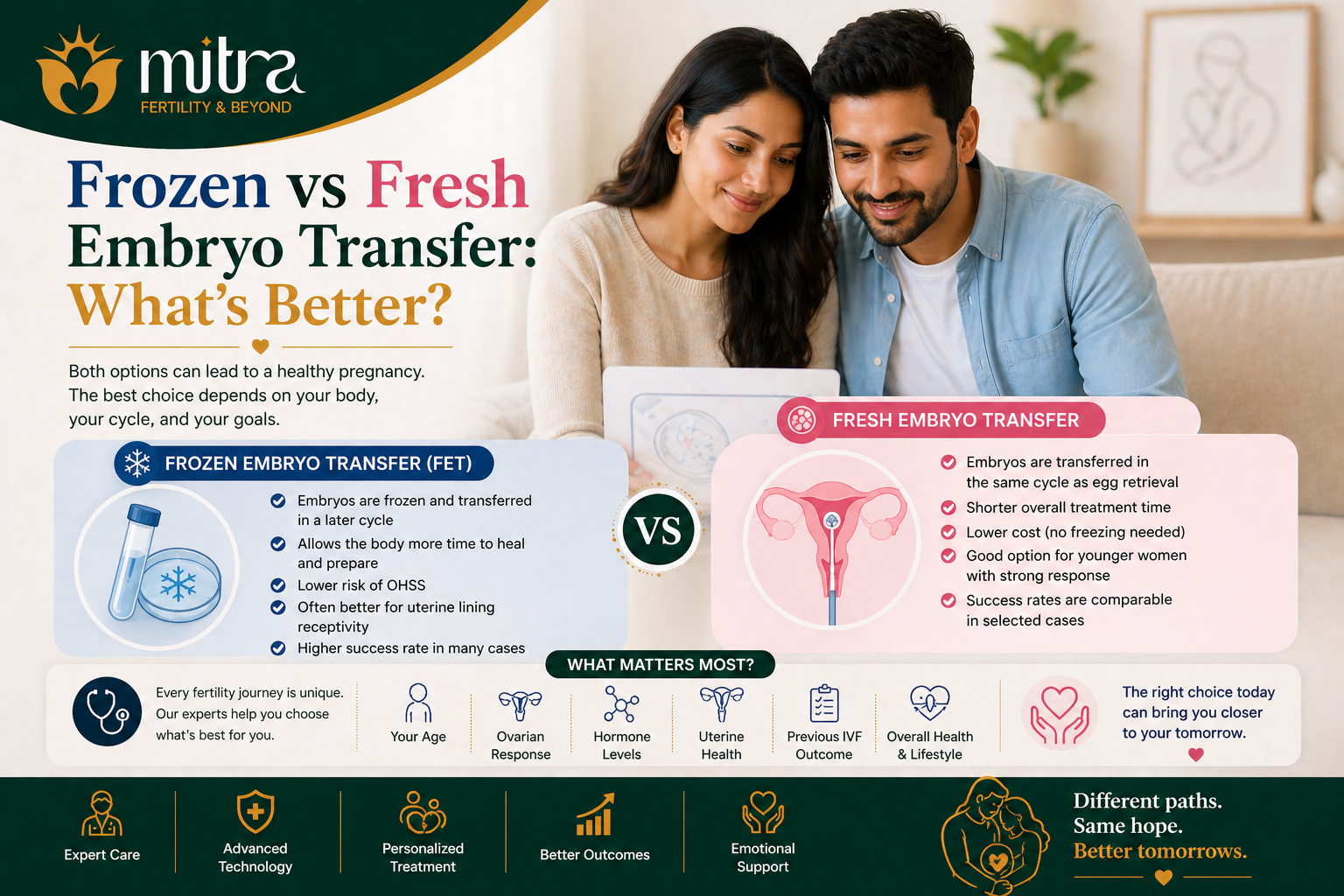
During an IVF journey, one important decision is choosing between a fresh embryo transfer and a frozen embryo transfer (FET).
Both methods aim to achieve the same goal—a successful pregnancy—but they differ in timing, preparation, and sometimes outcomes.
So, which is better?
The answer depends on your individual condition and treatment plan.
The answer depends on your individual condition and treatment plan.
What is a Fresh Embryo Transfer?
In a fresh embryo transfer:
Eggs are retrieved
Fertilized in the lab
The embryo is transferred into the uterus within the same cycle (usually after 3–5 days)
Eggs are retrieved
Fertilized in the lab
The embryo is transferred into the uterus within the same cycle (usually after 3–5 days)
Key point:
Everything happens in one continuous cycle.
What is a Frozen Embryo Transfer (FET)?
In a frozen embryo transfer:
Embryos are created and then frozen (cryopreserved)
Transfer happens in a later cycle after preparing the uterus
Embryos are created and then frozen (cryopreserved)
Transfer happens in a later cycle after preparing the uterus
Key point:
There is a gap between embryo creation and transfer.
Frozen vs Fresh Embryo Transfer: Key Differences
Factor
Fresh Transfer
Frozen Transfer (FET)
Timing
Same cycle
Later cycle
Uterine Preparation
Immediate
More controlled
Hormonal Environment
May be elevated
More balanced
Flexibility
Limited
High
Use with PGT
Less common
Preferred
Factor | Fresh Transfer | Frozen Transfer (FET) |
Timing | Same cycle | Later cycle |
Uterine Preparation | Immediate | More controlled |
Hormonal Environment | May be elevated | More balanced |
Flexibility | Limited | High |
Use with PGT | Less common | Preferred |
Success Rates: Which is Better?
In recent years, frozen embryo transfers have shown equal or sometimes higher success rates compared to fresh transfers.
Why FET may perform better:
The uterus is given time to recover
Hormone levels are more stable
Better synchronization between embryo and uterine lining
However, success depends on:
Age
Embryo quality
Overall health
The uterus is given time to recover
Hormone levels are more stable
Better synchronization between embryo and uterine lining
Age
Embryo quality
Overall health
When is Fresh Embryo Transfer Recommended?
Fresh transfer may be suitable when:
Hormone levels are well balanced
No risk of ovarian hyperstimulation
Uterine lining is optimal
First-time IVF with no complications
It is a faster option since everything happens in one cycle.
Hormone levels are well balanced
No risk of ovarian hyperstimulation
Uterine lining is optimal
First-time IVF with no complications
When is Frozen Embryo Transfer Recommended?
FET is often preferred in cases of:
High hormone levels after stimulation
Risk of ovarian hyperstimulation syndrome (OHSS)
Need for genetic testing (PGT)
Uterine lining not ready for implantation
Previous failed IVF cycles
It allows better control and planning.
High hormone levels after stimulation
Risk of ovarian hyperstimulation syndrome (OHSS)
Need for genetic testing (PGT)
Uterine lining not ready for implantation
Previous failed IVF cycles
Advantages of Frozen Embryo Transfer
More controlled uterine environment
Higher implantation success in many cases
Flexibility in timing
Reduced risk of complications
More controlled uterine environment
Higher implantation success in many cases
Flexibility in timing
Reduced risk of complications
Advantages of Fresh Embryo Transfer
Shorter overall timeline
No need for freezing and thawing
Fewer steps involved
Shorter overall timeline
No need for freezing and thawing
Fewer steps involved
Are Frozen Embryos Safe?
Yes. Modern freezing techniques (vitrification) ensure:
High survival rates after thawing
No significant impact on embryo quality
Safe and widely used globally
High survival rates after thawing
No significant impact on embryo quality
Safe and widely used globally
Common Myths About Frozen vs Fresh Transfers
Myth 1: Fresh is Always Better
Fact: Frozen transfers often perform equally or better.
Myth 2: Freezing Damages Embryos
Fact: Modern techniques preserve embryo quality effectively.
Myth 3: Frozen Transfers Take Too Long
Fact: While slightly delayed, they may improve success chances.
Which Option is Right for You?
The decision depends on:
Your hormone levels
Uterine condition
IVF history
Doctor’s recommendation
There is no one-size-fits-all answer—personalization is key.
Your hormone levels
Uterine condition
IVF history
Doctor’s recommendation
Conclusion
Both fresh and frozen embryo transfers are effective—but they serve different purposes.
Fresh transfer offers speed
Frozen transfer offers better control and flexibility
Choosing the right approach can significantly impact your IVF success.

PCOS Has Been Renamed PMOS — Here’s What It Means for Your Fertility
If you have PCOS — or think you might — there is news you need to know about. Yesterday, 12 May 2026, one of the
PGT-A in IVF: Understanding Genetic Embryo Screening
Blogs and Resources PGT-A in IVF: Understanding Genetic Embryo Screening Book Appointment PGT-A in IVF: Understanding Genetic Embryo Screening Introduction IVF treatment has advanced significantly
ICSI vs Conventional IVF: Key Differences Explained
Blogs and Resources ICSI vs Conventional IVF: Key Differences Explained Book Appointment ICSI vs Conventional IVF: Key Differences Explained Introduction When exploring fertility treatments, many

Failed IVF Cycle: Reasons & Next Steps
Blogs and Resources Failed IVF Cycle: Reasons & Next Steps Book Appointment Failed IVF Cycle: Reasons & Next Steps Introduction A failed IVF cycle can

Common IVF Mistakes That Reduce Success Rates
Blogs and Resources Common IVF Mistakes That Reduce Success Rates Book Appointment Common IVF Mistakes That Reduce Success Rates Introduction IVF (In Vitro Fertilization) has

Boost Your Fertility: Lifestyle & Health Tips for Trying to Conceive
Blogs and Resources Boost Your Fertility: Lifestyle & Health Tips for Trying to Conceive Book Appointment Boost Your Fertility: Lifestyle & Health Tips for Trying

Lifestyle Changes That Can Boost Fertility Naturally
Blogs and Resources Lifestyle Changes That Can Boost Fertility Naturally Book Appointment Lifestyle Changes That Can Boost Fertility Naturally Introduction Fertility is not just about

Foods to Eat and Avoid During IVF Treatment
Blogs and Resources Foods to Eat and Avoid During IVF Treatment Book Appointment Foods to Eat and Avoid During IVF Treatment Introduction When undergoing IVF

PCOS and Infertility: Latest Treatment Options
Blogs and Resources PCOS and Infertility: Latest Treatment Options Book Appointment PCOS and Infertility: Latest Treatment Options Introduction Polycystic Ovary Syndrome (PCOS) is one of
Latest Advances in IVF Technology
Blogs and Resources Latest Advances in IVF Technology Book Appointment Latest Advances in IVF Technology Introduction IVF (In Vitro Fertilization) has come a long way