

IVF vs IUI: Which Treatment Is Right for You?
Introduction
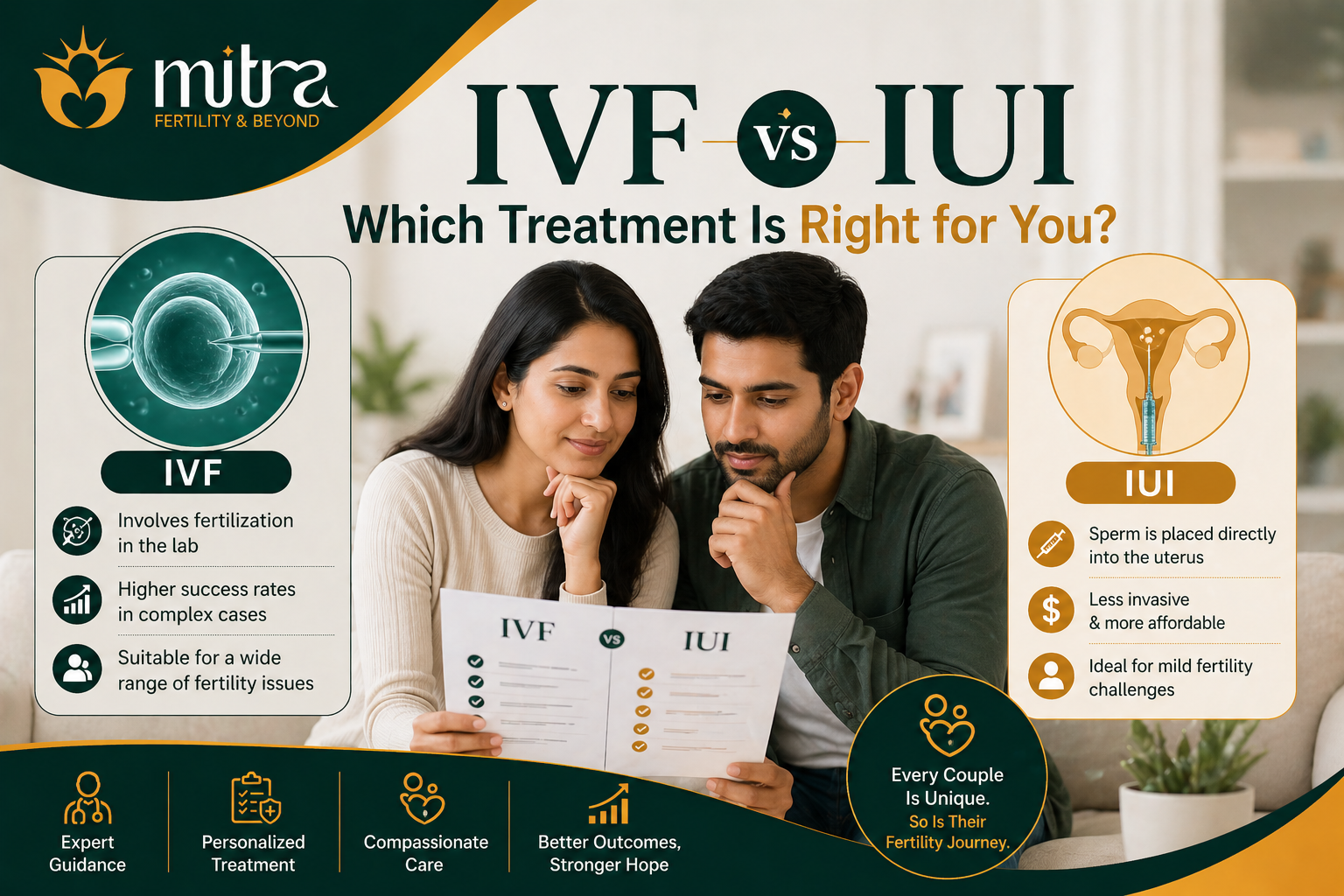
When couples face difficulty in conceiving, two of the most commonly recommended treatments are IUI (Intrauterine Insemination) and IVF (In Vitro Fertilization).
But choosing between IVF vs IUI can be confusing.
Both treatments aim to improve the chances of pregnancy—but they differ in process, cost, success rates, and suitability.
This guide helps you understand the difference and decide which treatment might be right for you.
What is IUI (Intrauterine Insemination)?
IUI is a relatively simple fertility treatment where processed sperm is directly placed into the uterus during ovulation.
Key Highlights:
Less invasive procedure
Shorter treatment cycle
Lower cost compared to IVF
IUI works by increasing the number of sperm that reach the egg.
Less invasive procedure
Shorter treatment cycle
Lower cost compared to IVF
What is IVF (In Vitro Fertilization)?
IVF is a more advanced treatment where eggs are retrieved from the ovaries, fertilized in a lab, and the embryo is transferred into the uterus.
Key Highlights:
Highly controlled fertilization process
Advanced lab techniques involved
Higher success rates
IVF is often recommended when other treatments fail or in more complex infertility cases.
Highly controlled fertilization process
Advanced lab techniques involved
Higher success rates
IVF vs IUI: Key Differences
Factor
IUI
IVF
Procedure
Simple
Advanced
Invasiveness
Minimal
Moderate
Cost
Lower
Higher
Success Rate
10–20% per cycle
40–60% per cycle
Time to Results
Short
Slightly longer
Monitoring
Basic
Intensive
Factor | IUI | IVF |
Procedure | Simple | Advanced |
Invasiveness | Minimal | Moderate |
Cost | Lower | Higher |
Success Rate | 10–20% per cycle | 40–60% per cycle |
Time to Results | Short | Slightly longer |
Monitoring | Basic | Intensive |
Success Rates: IUI vs IVF
IUI Success Rate
Typically 10% to 20% per cycle
Higher in younger couples with mild infertility
Typically 10% to 20% per cycle
Higher in younger couples with mild infertility
IVF Success Rate
Around 40% to 60% per cycle
Higher success in controlled lab conditions
If multiple IUI cycles fail, IVF is often the next recommended step.
Around 40% to 60% per cycle
Higher success in controlled lab conditions
When is IUI the Right Choice?
IUI may be suitable if:
You have mild male infertility
Unexplained infertility
Ovulation issues
Cervical mucus problems
You are younger (under 35)
It is often considered a first-line treatment before moving to IVF.
You have mild male infertility
Unexplained infertility
Ovulation issues
Cervical mucus problems
You are younger (under 35)
When is IVF the Better Option?
IVF is recommended in more complex situations such as:
Blocked or damaged fallopian tubes
Severe male infertility
Low ovarian reserve
Endometriosis
Failed IUI attempts
IVF provides better control and higher success in such cases.
Blocked or damaged fallopian tubes
Severe male infertility
Low ovarian reserve
Endometriosis
Failed IUI attempts
Which Treatment Should You Choose?
The right choice depends on:
Age
Cause of infertility
Duration of trying
Medical history
Budget and time considerations
There is no one-size-fits-all answer—treatment should always be personalized.
Age
Cause of infertility
Duration of trying
Medical history
Budget and time considerations
Common Mistake to Avoid
Many couples delay IVF assuming IUI will always work.
In some cases, this delay can reduce overall chances—especially with increasing age.
Conclusion
Both IUI and IVF have their place in fertility treatment.
IUI is a good starting point for simpler cases
IVF offers higher success for complex conditions
The key is choosing the right treatment at the right time.

PCOS Has Been Renamed PMOS — Here’s What It Means for Your Fertility
If you have PCOS — or think you might — there is news you need to know about. Yesterday, 12 May 2026, one of the
PGT-A in IVF: Understanding Genetic Embryo Screening
Blogs and Resources PGT-A in IVF: Understanding Genetic Embryo Screening Book Appointment PGT-A in IVF: Understanding Genetic Embryo Screening Introduction IVF treatment has advanced significantly
ICSI vs Conventional IVF: Key Differences Explained
Blogs and Resources ICSI vs Conventional IVF: Key Differences Explained Book Appointment ICSI vs Conventional IVF: Key Differences Explained Introduction When exploring fertility treatments, many

Failed IVF Cycle: Reasons & Next Steps
Blogs and Resources Failed IVF Cycle: Reasons & Next Steps Book Appointment Failed IVF Cycle: Reasons & Next Steps Introduction A failed IVF cycle can

Common IVF Mistakes That Reduce Success Rates
Blogs and Resources Common IVF Mistakes That Reduce Success Rates Book Appointment Common IVF Mistakes That Reduce Success Rates Introduction IVF (In Vitro Fertilization) has

Boost Your Fertility: Lifestyle & Health Tips for Trying to Conceive
Blogs and Resources Boost Your Fertility: Lifestyle & Health Tips for Trying to Conceive Book Appointment Boost Your Fertility: Lifestyle & Health Tips for Trying

Lifestyle Changes That Can Boost Fertility Naturally
Blogs and Resources Lifestyle Changes That Can Boost Fertility Naturally Book Appointment Lifestyle Changes That Can Boost Fertility Naturally Introduction Fertility is not just about

Foods to Eat and Avoid During IVF Treatment
Blogs and Resources Foods to Eat and Avoid During IVF Treatment Book Appointment Foods to Eat and Avoid During IVF Treatment Introduction When undergoing IVF

PCOS and Infertility: Latest Treatment Options
Blogs and Resources PCOS and Infertility: Latest Treatment Options Book Appointment PCOS and Infertility: Latest Treatment Options Introduction Polycystic Ovary Syndrome (PCOS) is one of

Latest Advances in IVF Technology
Blogs and Resources Latest Advances in IVF Technology Book Appointment Latest Advances in IVF Technology Introduction IVF (In Vitro Fertilization) has come a long way