
Failed IVF Cycle: Reasons & Next Steps
Introduction
A failed IVF cycle can be emotionally overwhelming. After putting in time, effort, and hope, not getting the expected result can feel discouraging.
But it’s important to understand this—a failed IVF cycle is not the end of your journey.
Many couples go on to achieve successful pregnancies in subsequent attempts. The key lies in understanding why the cycle failed and what steps to take next.
What is a Failed IVF Cycle?
An IVF cycle is considered unsuccessful when:
The embryo does not implant
Pregnancy is not confirmed after embryo transfer
This can happen even when everything seems to go well during the process.
The embryo does not implant
Pregnancy is not confirmed after embryo transfer
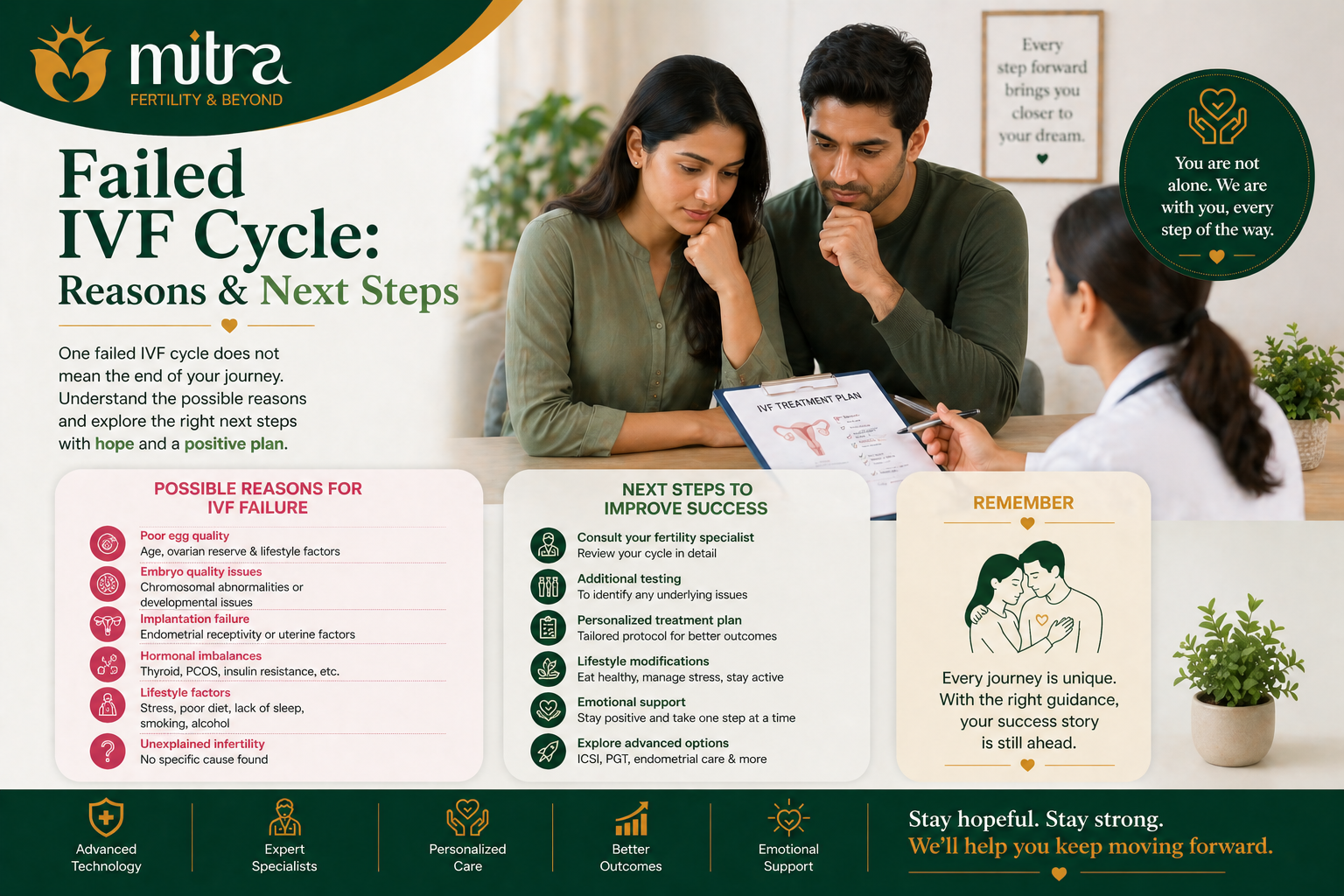
Common Reasons for IVF Failure
There is rarely a single reason. IVF failure is usually due to a combination of factors.
1. Poor Embryo Quality
Even if fertilization occurs, not all embryos develop properly.
Why it happens:
Poor egg or sperm quality
Genetic abnormalities
Healthy embryos are essential for successful implantation.
Poor egg or sperm quality
Genetic abnormalities
2. Implantation Failure
Sometimes, even good-quality embryos do not implant in the uterus.
Possible causes:
Uterine lining issues
Hormonal imbalance
Immune-related factors
Uterine lining issues
Hormonal imbalance
Immune-related factors
3. Age-Related Factors
Fertility declines with age, especially after 35.
Impact:
Reduced egg quality
Higher chances of chromosomal abnormalities
This can affect embryo development and implantation.
Reduced egg quality
Higher chances of chromosomal abnormalities
4. Uterine Conditions
Issues within the uterus can interfere with implantation.
Examples:
Fibroids
Polyps
Thin endometrial lining
Fibroids
Polyps
Thin endometrial lining
5. Hormonal Imbalance
Proper hormone levels are crucial for:
Egg development
Uterine preparation
Imbalances can reduce the chances of success.
Egg development
Uterine preparation
6. Lifestyle Factors
Certain habits can negatively affect IVF outcomes:
Smoking
Alcohol consumption
Poor diet
High stress levels
Smoking
Alcohol consumption
Poor diet
High stress levels
7. Laboratory or Protocol Factors
In some cases, success depends on:
Lab quality
Embryo handling
Treatment protocol
Even small variations can impact outcomes.
Lab quality
Embryo handling
Treatment protocol
What Happens After a Failed IVF Cycle?
The next step is evaluation and planning.
Your doctor will review:
Embryo quality
Response to medications
Uterine condition
Hormonal patterns
This helps identify possible improvements for the next cycle.
Embryo quality
Response to medications
Uterine condition
Hormonal patterns
Next Steps After IVF Failure
1. Detailed Medical Review
A thorough analysis of the previous cycle helps identify what could be improved.
2. Modify Treatment Protocol
Doctors may adjust:
Medication dosage
Stimulation approach
Timing of procedures
Personalization increases chances in the next cycle.
Medication dosage
Stimulation approach
Timing of procedures
3. Consider Advanced Techniques
Depending on your condition, options may include:
ICSI (for sperm-related issues)
Genetic testing of embryos (PGT)
Frozen embryo transfer (FET)
ICSI (for sperm-related issues)
Genetic testing of embryos (PGT)
Frozen embryo transfer (FET)
4. Address Underlying Issues
If specific problems are identified:
Treat uterine conditions
Correct hormonal imbalances
Improve overall health
Treat uterine conditions
Correct hormonal imbalances
Improve overall health
5. Take Time Before the Next Cycle
A short break allows:
Physical recovery
Emotional healing
Better preparation
Physical recovery
Emotional healing
Better preparation
Emotional Impact of IVF Failure
It’s normal to feel:
Disappointed
Frustrated
Anxious about the future
Acknowledging these emotions is important.
Disappointed
Frustrated
Anxious about the future
Helpful steps:
Talk to your partner or support system
Seek counseling if needed
Give yourself time to process
Talk to your partner or support system
Seek counseling if needed
Give yourself time to process
Can You Still Get Pregnant After IVF Failure?
Yes. Many couples succeed after one or more failed cycles.
Each attempt provides insights that improve future outcomes.
With the right approach, chances of success often increase in subsequent cycles.
How to Improve Success in the Next Cycle
Choose a personalized treatment plan
Follow medical advice strictly
Maintain a healthy lifestyle
Manage stress effectively
Stay informed without overthinking
Consistency and the right strategy make a difference.
Choose a personalized treatment plan
Follow medical advice strictly
Maintain a healthy lifestyle
Manage stress effectively
Stay informed without overthinking
Conclusion
A failed IVF cycle is not a failure—it’s part of the process for many couples.
Understanding the reasons and taking the right next steps can bring you closer to success.
Your journey may take time—but progress is still happening